
Money is the first vote of confidence a campaign earns.
We build the whole fundraising machine: the plan, the donation platform, the online program, call time, the donor network and the events that close the big gifts.
How does a political campaign raise money?
A campaign raises money with a written finance plan and several programs running at once: personal asks and call time to the candidate's network, a finance committee and hosts who bring in their own networks, house parties and large donor events, and an online program of donation pages, email and text that brings in small and recurring gifts. Every dollar is reported, every donor is thanked, and the network is built to last beyond one election. URSA plans and runs all of it.
Fundraising is not a tax on the campaign's time. It is the campaign's first organizing program.
Start With the Finance Plan
Every number in a fundraising plan comes from the campaign plan. We work backward from what it takes to win.
Budget from the win number
Streaming TV, mail, digital, outdoor and field, priced against the voters the campaign has to reach. The budget sets the fundraising goal, not the other way around.
Goals by source
How much comes from the candidate's network, major donors, events, PACs and associations, and online small dollar giving, with a realistic number for each.
A month by month calendar
Targets for each month, timed to when the money is needed and to the campaign finance reporting deadlines, because a strong report is its own fundraising and press tool.
The finance committee
Supporters who each commit to raise, not just give, from their own circles. The committee multiplies the candidate's reach.
Treasurer and compliance first
A campaign treasurer on file before the first dollar, the right reporting authority, and the rules for who can give and how much, set up before the first ask.
Online Fundraising
Small and recurring donors are the campaign's broadest base of support. The online program turns supporters into donors, and donors into recurring donors.
Donation platform setup and integration
We set up and integrate the right processor for the campaign (WinRed for Republican candidates, ActBlue for Democrats, or a nonpartisan platform for nonpartisan races and committees), connected to the website, email and text, so donors have a seamless experience.
Donation pages that convert
Fast, mobile first pages with suggested amounts, a recurring option, the required contributor fields and the disclosure, branded to the campaign.
Email fundraising
A list built from supporters and sign ups, with a steady schedule of updates and asks tied to real moments: a report deadline, an endorsement, an opponent's attack, early voting.
Text fundraising
Personal asks to supporters by text, with links to the donation page. Compliance rules for texting apply, including opt outs and texting hours.
Donor acquisition ads
Digital ads that grow the supporter and donor list, aimed at people likely to share the campaign's values.
Recurring giving
Monthly donors give more over a campaign than one time donors and make the budget predictable. Every page and email offers it.
No fake deadlines. No fake matches.
We do not use invented emergencies, fake matching gifts or pre-checked recurring boxes. They raise money this week and burn donors for good. Honest urgency, real milestones and gratitude raise more over a full campaign.
Call time, done right.
For most candidates, the largest early dollars come from their own phone. Call time is the most effective and least loved part of the job, so we make it efficient.
We build prospect lists from the candidate's contacts, the finance committee's networks and public campaign finance reports of people who give to similar races. Each call gets a sheet with the prospect's history and a specific ask amount, a short script, and a follow up the same day: a thank you, a pledge reminder or a link to give. Pledges are tracked until they are collected.

Building Your Fundraising Network
A campaign's donors are a network, not a list. We build it in rings, each one reaching further than the last.
Your first hundred
Family, friends, colleagues, clients, church and neighbors. Early money from people who know the candidate is the signal everyone else watches for.
The finance committee
Supporters who each commit to a raise goal and bring in their own circles. The most important fundraising decision a campaign makes is who sits on it.
Hosts and bundlers
People with strong networks who host events and collect gifts from their friends, multiplying what the candidate can reach personally.
Industry and community networks
Professional associations, business groups, neighborhood leaders and civic clubs whose members care about the office.
PACs and associations
Political committees that support candidates and causes aligned with the campaign, approached with a clear case and the campaign's numbers.
Endorsements that open doors
Every respected endorsement is also an introduction to that person's network. We pair each endorsement with an ask.
Large donor events that close the big gifts.
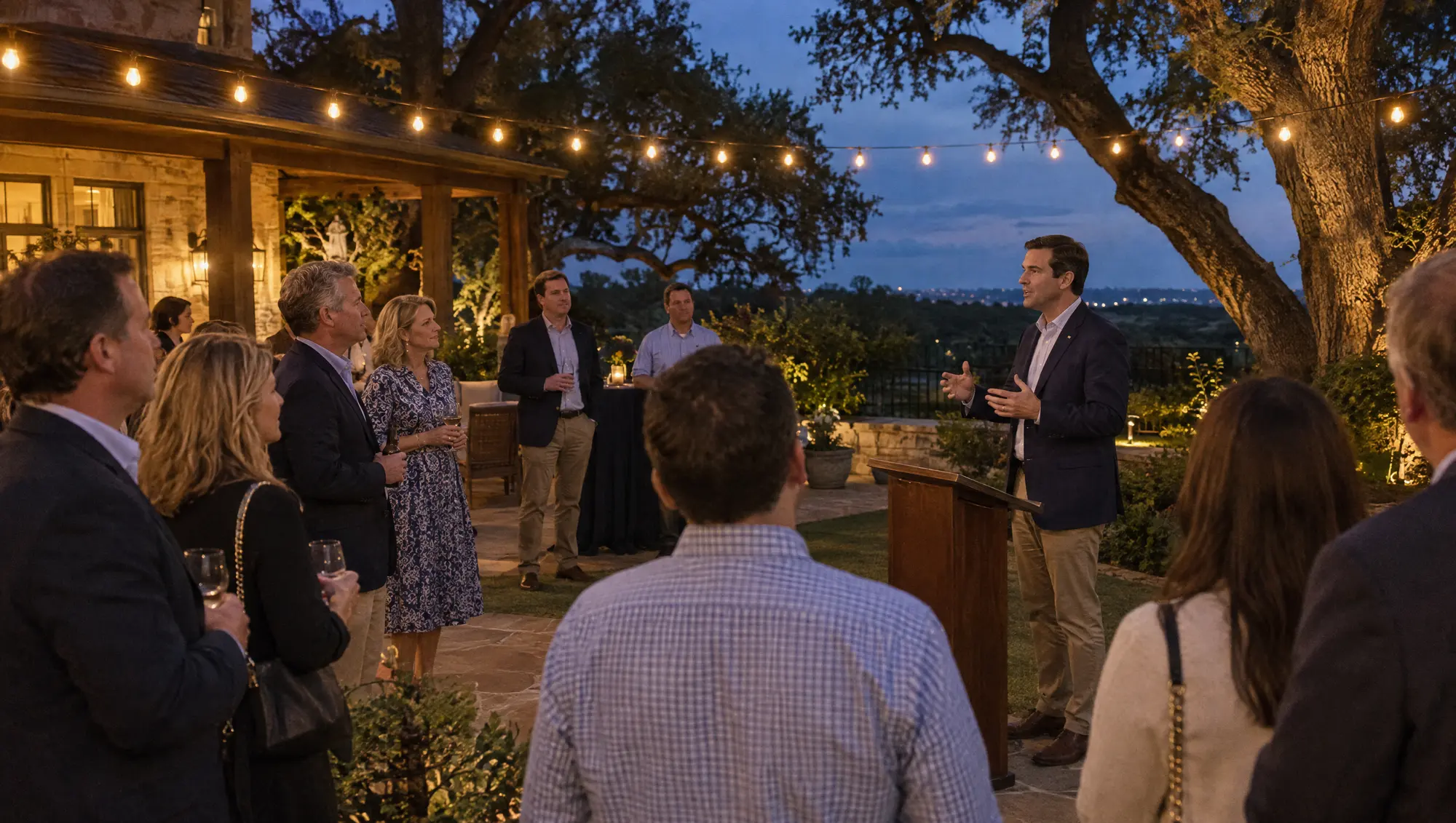
A reception with the right host, the right room and the right ask raises more in one evening than months of small asks.
How We Run a Large Donor Event
Set the goal and the host committee
A dollar goal for the night and a host committee whose names are on the invitation, each committed to fill seats and raise a share of the goal.
Choose the room
A host's home, a ranch, a club or a venue that fits the crowd. A great home with a great host often beats a ballroom.
Build the giving levels
Host, sponsor and guest levels with clear amounts and what each includes, such as a private reception or a photo with the candidate.
Invite from the network
Printed invitations, personal emails and calls from hosts, with an online page for tickets and gifts. RSVPs tracked to the dollar.
Run the program
Arrival, a short host welcome, the candidate's remarks, a clear ask and pledge cards, all in under an hour of program. The ask is never left to chance.
Follow up within two days
Thank you notes and calls, pledge collection, and a personal follow up to every guest who did not give yet.
Smaller Events That Build the Base
House parties
A supporter invites twenty neighbors, the candidate drops by, and the host makes the ask. Cheap to run, and every guest is a future volunteer or donor.
Meet and greets
Coffee shops, community centers and front porches. Low dollar, high value, and they feed the volunteer list.
Kickoffs and rallies
Launch events that combine a show of support with ticketed giving and sign ups.
Virtual events
Short online briefings for donors who cannot attend in person, followed by a direct ask.
Keep Donors for the Next Campaign
Thank every donor
Every gift acknowledged quickly, larger gifts with a personal call or handwritten note. See SmartMail.
Report back
Donors who see what their money did, a new ad, a big endorsement, a strong report, give again.
Recognize the network
Hosts, committee members and recurring donors invited to briefings and kept close.
Campaign Momentum™
After election day, we keep the candidate's name and work in front of supporters and donors, retire debt and lay the foundation for the next race.
Compliance Is Part of the Plan
Every campaign needs a campaign treasurer appointment on file with the right authority before it raises or spends money, and regular reports of contributions and expenditures. State and local races in Texas generally report to the Texas Ethics Commission or a local filing authority, and federal campaigns report to the Federal Election Commission.
The rules on who can give and how much depend on the race. In Texas, corporations and labor organizations generally cannot contribute to candidates. Most state and local Texas races have no contribution limits, but judicial races do under the Judicial Campaign Fairness Act, some cities set their own, and federal races have limits set by federal law. Every solicitation and donation page carries the required political advertising disclosure, and every donation page collects the contributor information the reports require.
We build these rules into the plan and the platforms from the first day. Campaigns should confirm the rules for their own race with their treasurer and counsel.
How much money does a local campaign need to raise?
Enough to reach the voters who decide the race, as many times as it takes. We build the budget from the win number and the channels needed to reach those voters, and the fundraising goal comes from that budget.
What donation platform should a campaign use?
Republican candidates commonly use WinRed, Democratic candidates commonly use ActBlue, and nonpartisan races and committees use nonpartisan processors. URSA sets up and integrates the platform with the campaign's website, email and text so the donor experience is seamless.
What is call time?
Call time is the scheduled time a candidate spends calling potential donors personally, with call sheets that show each prospect's history and a specific ask amount. It is usually the largest source of early money in a campaign.
How do you run a fundraising event for a campaign?
Set a dollar goal, recruit a host committee committed to filling seats and raising part of the goal, choose a fitting venue, set giving levels, invite from the hosts' networks, keep the program short with a clear ask, and follow up with thank yous and pledge collection within two days.
Can corporations donate to Texas candidates?
Generally no. Texas law prohibits corporations and labor organizations from making political contributions to candidates, with limited exceptions. Campaigns should confirm the rules for their race with their treasurer or counsel.
Are there contribution limits in Texas?
Most Texas state and local races have no contribution limits, but judicial races are limited under the Judicial Campaign Fairness Act, some cities set their own limits, and federal races have limits under federal law.
Keep reading.
- CandidatesFor first time and returning candidates for city, county, judicial, school board, state and federal office: name recognition, a reason to vote close to home, and the turnout to win.
- Volunteer MobilizationURSA recruits, equips and deploys campaign volunteers on Culper: invite links and roles, walk turf carved from the voter file, door scripts and surveys on the phone, live GPS tracking, P2P texting and sign crews.
- SmartMail Direct MailSmartMail is URSA's smarter direct mail: hand addressed, stamped letters with a 95% read rate, voter guides, before and after pieces, and variable printing that carries micro-targeting into every mailbox.
Your victory starts here.
Tell us where you are running or what is on your ballot. We will show you who decides it, what moves them, and what it costs to reach them.
Schedule a Consultation