
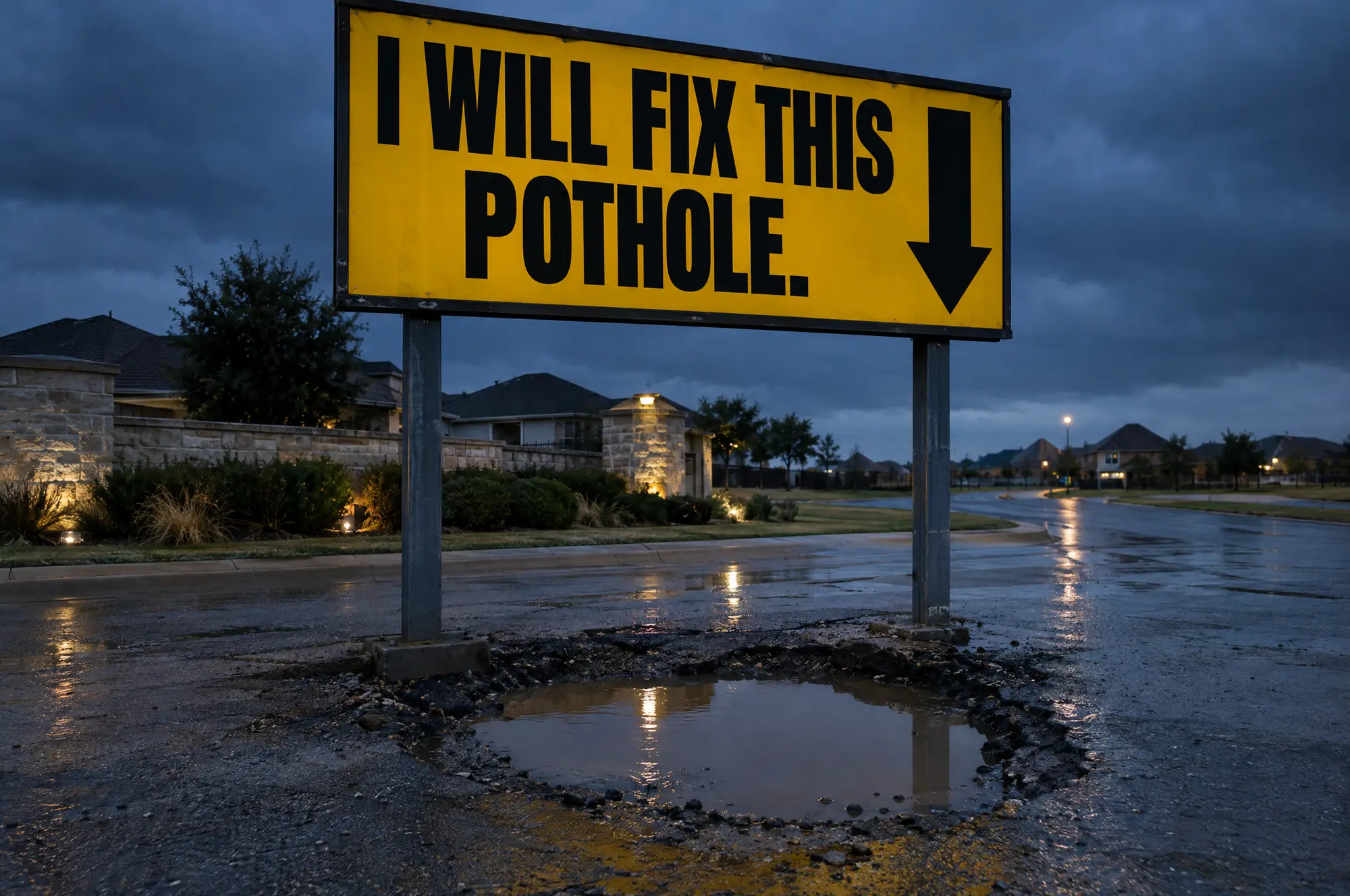
"I will fix this pothole." And an arrow pointing right at it.
Most political billboards are a name, a face and an office. Ours are placed where the issue is, about the issue, so the board and the problem make the argument together. It is micro-targeting you can see from the road.
What is strategic outdoor advertising in a campaign?
Strategic outdoor uses micro-targeting to choose where a billboard, digital board or sign goes and what it says. Instead of buying the busiest road for name recognition, URSA places boards at the local problem a neighborhood cares about, such as a pothole, a traffic choke point or a flooded street, with a message that ties the candidate to fixing it. Every driver who passes the problem sees the promise.
The Board Makes the Argument
Picture the entrance to a subdivision where everyone has been hitting the same pothole for a year. Every resident drives past it at least twice a day. They have reported it. Nothing happened.
Now picture a board right there with five words and an arrow pointing down at the hole. No platform, no slogan. The voter does not have to imagine the problem, because they are looking at it. They do not have to wonder whether the candidate understands the neighborhood, because the candidate clearly drove out to stand where they stand.
That one board does more than a hundred generic ones on the freeway, because it is about something only the people who see it care about. And they will see it every day until the election.
Five words and an arrow. The road does the rest.
Traditional Outdoor Versus Strategic Outdoor
Traditional political outdoor
- Placed on the highest traffic road the budget allows.
- Name, face, office. Built for name recognition.
- Most drivers do not live in the district or vote in the race.
- Says the same thing to everyone who passes.
Strategic outdoor
- Placed where the issue is: the pothole, the intersection, the school line, the ditch that floods.
- One promise about one problem, with the problem in view.
- Seen mostly by the residents who live with it, who are the voters in the race.
- Works with the same neighborhood's streaming, digital, mail and P2P messages.
Strategic Outdoor Formats
Issue boards
Static boards and large signs placed at the problem, on private property with the owner's permission, with a message about that problem.
Dayparted digital boards
Digital boards can change by hour. A board near a school can run "Stuck in this line again? I have a plan for a turn lane" only during morning drop off and afternoon pickup, when the parents are sitting in it.
Polling place signs
Signs at early voting and Election Day locations, placed outside the legal electioneering boundary. Paired with our persuasion scripts, the volunteers who stand them up become voters themselves.
Yard signs by the block
Yard signs placed for coverage, not just for supporters who asked for one. A street where every few houses has a sign tells neighbors which way the street is leaning.
Mobile billboards
A truck mounted board that can park at the community meeting, the high school game or the problem itself, for a day at a time.
Event and venue signage
Signs and banners where the district's voters gather: school athletic events, church festivals, farmers markets and civic club meetings.
How We Plan an Outdoor Program
Find the issue
Our micro-targeting work shows which neighborhoods care about which problems, from block walk notes, P2P conversations, neighborhood groups and public records.
Map it
We map the problem and the voters around it using CAD parcel data and the voter file, then look at the traffic: which roads the residents actually drive, and where they slow down or stop.
Secure the location
We find available inventory or private property owners willing to host a sign close to the issue, and confirm local sign rules for the spot.
Write five words
An outdoor message has a few seconds. One promise, the candidate's name and the required disclosure. The location does the rest.
Track every sign
Every board and sign is dropped on the Culper outdoor map with its size, location, installer and pickup date, so nothing is lost and nothing is left up after the election.
Echo it everywhere
The same neighborhood sees the same promise on streaming TV, in their Facebook feed, in the mailbox and in a text from a neighbor. The board is the anchor.
Playing by the Rules
Outdoor political advertising has rules, and breaking them gets signs removed and campaigns embarrassed. Signs need the property owner's permission. Highway right of way is off limits in Texas, and cities and counties have their own size and placement rules. In Texas, electioneering is prohibited within 100 feet of an outside door through which voters enter a polling place during voting (Texas Election Code 61.003), so polling place signs go outside that marker. Every political sign and board carries the required "paid for by" disclosure.
We check the rules for each location before anything goes up, and we pick up every sign afterward.
Do political billboards work for local races?
They work best when they are specific. A generic name and face board on a busy highway mostly reaches people outside the district. A board placed at a local problem, with a message about fixing it, reaches the residents who live with it every day and gives them a concrete reason to vote.
How close to a polling place can campaign signs be in Texas?
Texas Election Code 61.003 prohibits electioneering within 100 feet of an outside door through which a voter may enter a building with a polling place, during the voting period. Polling locations usually mark that distance. Local rules for the property may also apply.
Can a billboard target a specific neighborhood?
Yes, by placement. Outdoor cannot choose who sees it, but it can choose where it stands. Placing a board at a subdivision entrance, a school pickup line or a specific intersection means most of the people who pass it are the residents of that neighborhood.
How do you keep track of campaign signs?
Every sign and board is logged on Culper's outdoor map with its location, size, who installed it and who will collect it after the election, along with the pickup due date.
Keep reading.
- Micro-TargetingURSA finds the issues voters feel at the end of their own street, like the pothole, the carpool line and the road where people dump pets, and targets those households with messages that drive them to vote.
- Persuasion PsychologyWhy "go vote" fails and a one to one ask works. URSA writes persuasion scripts for Culper peer-to-peer texting that turn supporters into voters, built on decades of turnout research.
- Local ElectionsURSA helps candidates win county judge, commissioner, justice of the peace, judicial, city council, mayor and school board races with micro-targeting, streaming TV, P2P persuasion scripts and strategic outdoor.
Your victory starts here.
Tell us where you are running or what is on your ballot. We will show you who decides it, what moves them, and what it costs to reach them.
Schedule a Consultation