Diffusion of responsibility
What the research foundWhen people believe many others could respond, each person is less likely to step in. The effect drops sharply when one person is clearly the one being asked.
How we use itEvery script names the voter, comes from a named volunteer, and makes the task theirs alone. "Can you take 7:00?" leaves no one else to do it.
Darley and Latané, Journal of Personality and Social Psychology, 1968.
The foot in the door
What the research foundIn a classic study, homeowners who first agreed to display a small sign about safe driving were far more likely, weeks later, to agree to a large, unattractive sign in their front yard than homeowners asked only the big request. Saying yes to something small changes how people see themselves.
How we use itWe start with a request almost anyone will grant: a quick favor, a sign, a time slot. Each yes makes the next one, including the ballot, more natural.
Freedman and Fraser, Journal of Personality and Social Psychology, 1966.
Commitment and consistency
What the research foundPeople feel strong pressure to act in line with what they have already said, especially when the commitment is active, voluntary and made to another person.
How we use itThe voter types the yes themselves, to a real person. That reply is a public, active commitment, and we follow up to confirm it the night before.
Robert Cialdini, Influence: The Psychology of Persuasion, 1984.
Plan making
What the research foundVoters asked to think through when they will vote, where, and how they will get there turned out at higher rates than voters given a standard encouragement. The effect was strongest for people who live alone, who have no one else in the house to remind them.
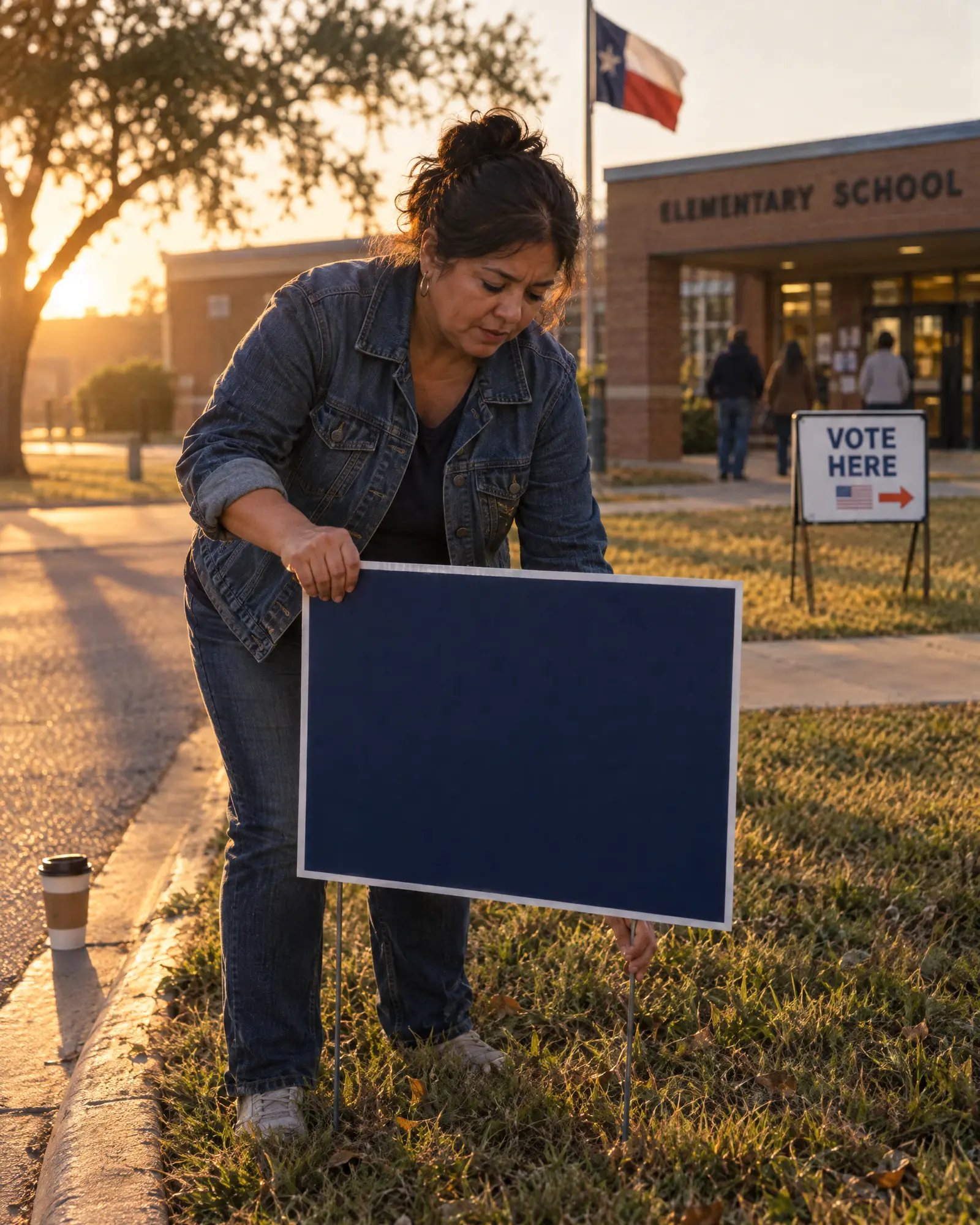
How we use itThe sign ask is a voting plan in disguise. It sets the place (their polling location), the time (7:00) and the reason to be there. The voter never has to make the plan, because the favor made it for them.
Nickerson and Rogers, Psychological Science, 2010.
Identity, not just action
What the research foundPeople asked about "being a voter" turned out at higher rates than people asked about "voting". A noun invites people to claim an identity, and people work to live up to identities they value.
How we use itOur scripts make the voter part of the team: "our sign", "we need someone", a volunteer, a precinct captain, a neighbor helping neighbors. People who help run the effort see themselves as people who show up.
Bryan, Walton, Rogers and Dweck, Proceedings of the National Academy of Sciences, 2011.
Being seen
What the research foundA large field experiment found that turnout rose by about eight percentage points when voters were told their neighbors would see whether they had voted. Visibility to other people is one of the most powerful turnout levers ever measured.
How we use itWe do not shame anyone, and we never publish who voted. We get the same effect in a positive way. A person standing a sign up at the polls is visibly part of the election, in front of their own neighbors, and a volunteer is expecting them.
Gerber, Green and Larimer, American Political Science Review, 2008.
Personal contact beats mass contact
What the research foundDecades of randomized turnout experiments find that the closer a contact feels to a real conversation with a real person, the more it raises turnout. Impersonal, mass produced contact does far less.
How we use itThis is why the scripts run through peer-to-peer texting, not blast texts. A volunteer sends each message by hand, reads the reply and answers it. It is a conversation, which is the thing the research says works.
Green and Gerber, Get Out the Vote: How to Increase Voter Turnout.